
CV or resume — same thing, right?
Most people use the terms interchangeably. But when it actually matters — say, during a job application — the difference suddenly becomes important. The structure, intent, and outcomes are not the same.
Something similar is happening in the world of index funds today.
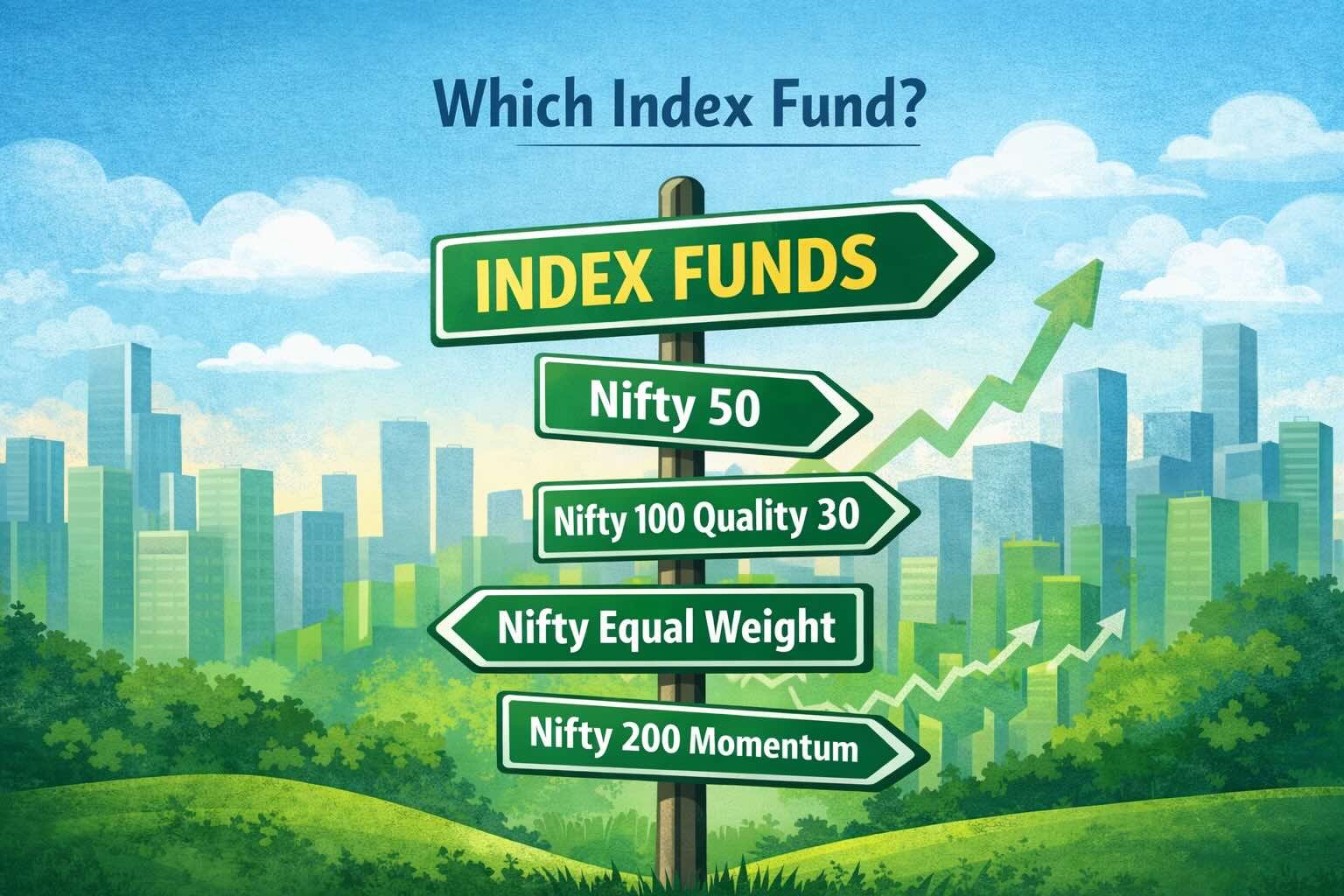
We casually say, “Just invest in an index fund,” as if it’s one obvious, straightforward choice. In reality, index investing in India has evolved into a growing list of similar-sounding options — enough to confuse not just investors, but even mutual fund distributors.
Large-cap index fund? Sure.
But which large-cap index?
The Quiet Evolution of Index Funds in India
A decade ago, index investing was refreshingly simple. Most investors had just two familiar choices:
- Nifty 50
- BSE Sensex
That simplicity no longer exists.
Today, even within the large-cap universe alone, investors encounter names such as:
- Nifty 50 Index
- Nifty Next 50 Index
- Nifty 50 Equal Weight Index
- Nifty 100 Index
- Nifty 100 Equal Weight Index
- Nifty 100 Low Volatility 30 Index
- Nifty 100 Quality 30 Index
- Nifty Top 10 Equal Weight Index
- BSE Sensex Index
And these are only indices, not mutual fund schemes.
Once multiple AMCs launch funds tracking each of these indices, the number of choices multiplies quickly.
Choice is good. Too much choice without context is not.
Same Market Cap. Very Different Journeys.
Most investors assume that all large-cap indices behave similarly. They don’t.
The difference lies not in the label “large cap,” but in how the index is constructed.
Let’s simplify this.
1️⃣ Traditional Market-Cap Weighted Indices
Examples
- Nifty 50
- BSE Sensex
- Nifty 100
How they work
Stocks are weighted based on market capitalization. The larger the company, the greater its influence on index returns.
What this means for investors
- High concentration in the top 5–10 companies
- Returns closely mirror headline market movements
- Lower churn and long history of data
These indices form the core building blocks of most passive portfolios.
2️⃣ Equal Weight Large-Cap Indices
Examples
- Nifty 50 Equal Weight
- Nifty 100 Equal Weight
- Nifty Top 10 Equal Weight
How they work
Every stock carries the same weight, regardless of size.
What changes
- Reduced concentration risk
- Higher exposure to relatively smaller large-cap stocks
- Higher volatility and more frequent rebalancing
These indices often perform well during broad-based market rallies, but may lag when returns are driven by a handful of mega-caps.
Same companies. Very different behaviour.
3️⃣ Factor-Based Large-Cap Indices
Examples
- Nifty 100 Low Volatility 30
- Nifty 100 Quality 30
How they work
Stocks are selected using predefined, rule-based factors such as:
- Price stability
- Profitability
- Balance-sheet strength
What investors should know
- These are not defensive guarantees, despite how they sound
- Performance varies across market cycles
- Periods of underperformance are normal and unavoidable
These indices introduce strategy into index investing.
And This Is Still Only Large Caps
If this already feels overwhelming, it’s worth noting that we haven’t moved beyond large caps yet.
Once we step into broader market indices, the complexity increases further.
Large & Mid-Cap and Broad Market Indices
Examples
- NIFTY Large Midcap 250 Index
- Nifty 200 Momentum 30
- Nifty 200 Quality 30
- Nifty Alpha Low Volatility 30
- BSE Low Volatility Index
These indices:
- Combine large and mid-cap stocks
- Use momentum, quality, or volatility screens
- Can behave very differently from plain vanilla index funds
At this point, index investing starts to resemble strategic allocation, not just passive exposure.
Mid-Cap, Small-Cap and Sectoral Indices Add More Layers
Beyond this lie:
- Mid-cap and Small-cap indices
- Factor variants within each category
- Sectoral indices like IT, Banking, Pharma, Realty, PSU
These indices are:
- More volatile
- More cyclical
- Heavily dependent on patience and discipline
Here, index investing is clearly not “set and forget.”
An Important Truth: Index Fund ≠ Passive Decision
While index funds are passive in portfolio construction, selecting an index is an active decision.
Different indices imply:
- Different volatility
- Different drawdowns
- Different recovery paths
- Different long-term experiences
Passive fund.
Active choice.
Just as a CV and a resume serve different purposes despite sounding similar, index funds demand understanding beyond their names.
How Should Investors Think About Index Funds Today?
Instead of chasing variety, investors may benefit from a simpler framework:
- Use broad, market-cap weighted indices as the portfolio core
- Add factor or thematic indices sparingly and consciously
- Avoid overlapping indices that unknowingly duplicate exposure
- Fewer well-understood indices held patiently often work better
Index funds were meant to simplify investing — not replace one form of complexity with another.
Final Thoughts
Index funds remain powerful tools for long-term wealth creation.
But in a world filled with similar-sounding indices and abundant choice, simplicity now requires understanding.
The goal isn’t to own every index.
It’s to own the right ones, for the right reasons, for long enough.
If you’re unsure whether your index fund choices are truly diversifying your portfolio — or quietly duplicating risk — it may help to step back and view the portfolio as a whole.
2 Comments
Leave A Comment Cancel reply
Join Our Mailing List
Once Weekly Webinar
Free Webinar Once Per Week
Our free webinar runs once per week and is available to anybody who wants to know more about getting started on the road to financial freedom.
Good Information….Very useful for me
Glad, you found it useful.