
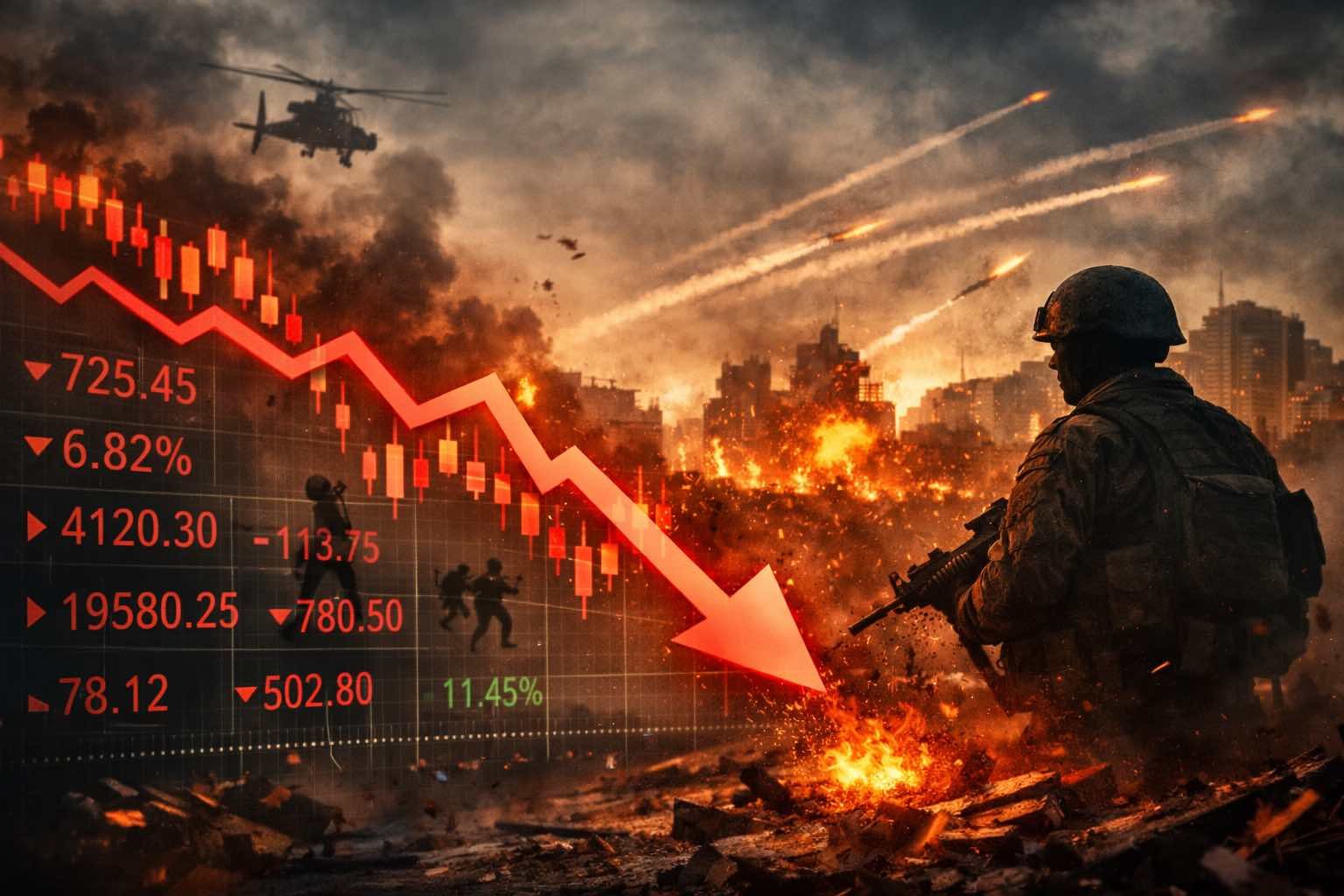
The headlines are loud.
War between Iran, the US and Israel.
The reported death of Ali Khamenei.
Closure of the Strait of Hormuz.
Oil fears. Diplomatic strain. Global uncertainty.
And markets? They are doing what markets always do when uncertainty rises — they tremble.
In the last 20 sessions, our benchmark NIFTY 50 has slipped 1,875 points — about 7.15%. Nearly 1,000 of those points were lost in just three sessions.
That feels dramatic.
But here’s the quiet truth:
Volatility is not an exception in markets. It is their natural posture.
Markets Don’t Fear War. They Fear Uncertainty.
History has seen wars, oil shocks, political assassinations and global stand-offs. Markets have fallen harder than this before.
And yet, over long periods, they have climbed.
When asked what the market would do next, J. P. Morgan reportedly replied,
“The market will fluctuate.”
Simple. Almost dismissive.
The real challenge isn’t the fall.
It’s our reaction to the fall.
Why Even Seasoned Investors Feel It
A new investor may have 4–5% of total wealth in equities. A 7% fall is uncomfortable but manageable.
But a seasoned investor?
70–80% allocation to equity is common.
When that large a portion of wealth moves sharply, you don’t just see it in your portfolio — you feel it in your chest.
Seasoned investors have seen cycles. They know markets can twist into strange yoga poses.
But here’s the honest question:
If a 7% correction is disturbing your sleep, was your allocation truly aligned with your risk tolerance?
Knowing volatility intellectually is different from absorbing it emotionally.
And that’s okay. Markets are great teachers.
“Stick to Asset Allocation” — But Understand What That Really Means
This phrase is often repeated casually. But a good asset allocation is not lazy advice. It is a complete system.
A sound allocation already assumes:
You have separated short-term money from long-term growth money.
Your next few years’ expenses are not dependent on equity markets.
You have an emergency buffer.
You have defined a rebalancing discipline.
When markets fall, one of two things happens:
Either your equity weight is still within your band — in which case you do nothing.
Or it has drifted lower — in which case rebalancing may require buying equity.
Yes, buying.
Corrections are not only events to endure.
Sometimes they are events to rebalance.
But the key is this — allocation decisions must be made in calm weather, not during storms.
If your allocation was decided with a steady head, this is not decision time.
This is discipline time.
For Active Participants: Hedge, Don’t Gamble
Some investors are not passive allocators. They trade stocks. They take momentum calls. They use Futures & Options.
Institutions routinely use derivatives to hedge risk. Used correctly, options can act like insurance.
But tools are neutral.
A knife can cut vegetables.
Or it can cut fingers.
In the last few years, retail participation in F&O has surged. And many participants have lost money — not because the tool is evil, but because it was used for speculation, not protection.
Hedging is like insurance.
In good times:
You pay the premium.
Returns look slightly lower.
In bad times:
Drawdowns are cushioned.
Panic reduces.
But insurance only works when:
Position sizes match exposure.
It is structured deliberately.
It is not oversized or emotionally driven.
Otherwise, it adds risk instead of reducing it.
One More Thing: Manage Your Media Diet
Volatility today is amplified by something previous generations didn’t face — 24×7 notifications.
If you check your portfolio every 15 minutes, don’t blame the market for your blood pressure.
You are not required to consume every breaking headline.
You are not required to react to every candle on the chart.
Sometimes the wisest move during global uncertainty is not financial — it is behavioural.
Reduce noise.
Increase patience.
As Morgan Housel beautifully puts it:
“Volatility is the price of admission. The prize inside is superior long-term returns.”
Let the Storm Pass
Geopolitics will shift.
Leaders will change.
Straits will reopen.
Markets will recover — and then panic again someday.
Your role is simpler than the headlines suggest.
Build a sensible allocation.
Separate short-term and long-term money.
Rebalance with discipline.
Use advanced tools only if you truly understand them.
And stay in the game.
Wealth is not built by predicting storms.
It is built by surviving them calmly.
Take a slower breath.
This too shall pass.
Join Our Mailing List
Once Weekly Webinar
Free Webinar Once Per Week
Our free webinar runs once per week and is available to anybody who wants to know more about getting started on the road to financial freedom.